

“Talk to My Agent”
How We All Become Movie Stars in the AI Age


Recently, I was attending a conference (Fintech NerdCon) and one of the AI start-ups had a clever punt on their shirts “Talk to my Agent”. Well, it got me thinking of course and I had to write about what it meant beyond the humor. Having the privilege of getting some insights from Adam Paul, I obviously went straight for Hollywood or the French TV series “10%”(Dix pour cent) on Netflix (check it out, it’s quite good).
So one of the quiet perks of being a movie star has always been that delicious line:
“You’ll have to talk to my agent.”
It’s elegant. It’s smug. It’s a human 404 error for unwanted admin.
For most of us, though, that line doesn’t work. If your plumber says “Talk to my agent,” you’re rightly concerned. If your neighbor says it when you ask about the HOA barbecue, you start checking the property values.
But in the age of AI agents?
Oh, it’s coming.
We are about to enter a world where everyone has an agent. Not a Hollywood one, but a swarm of tireless, slightly neurotic digital ones. They’ll negotiate. They’ll comparison-shop. They’ll coordinate schedules. They’ll argue with customer support. They’ll book travel, optimize your recurring subscriptions, and politely decline that 7:30am Zoom “coffee chat.”
And they won’t take 10% of your paycheck—unless, of course, you configure them to skim that into your savings jar for “Emergency Cheese & Champagne.”

From Red Carpet to Router: The Agent Goes Mainstream
The old world:
Only celebrities, CEOs, and that one unbearable guy on LinkedIn had agents.
Everyone else had calendars, spreadsheets, and ulcers.
The new world:
Your email has an agent.
Your banking has an agent.
Your fridge might have an agent (“We need to talk about your butter consumption.”).
Instead of one overworked human assistant juggling 20 things badly, you’ll have a network of AI agents orchestrating your life like a hyper-organized stage manager with a caffeine problem.
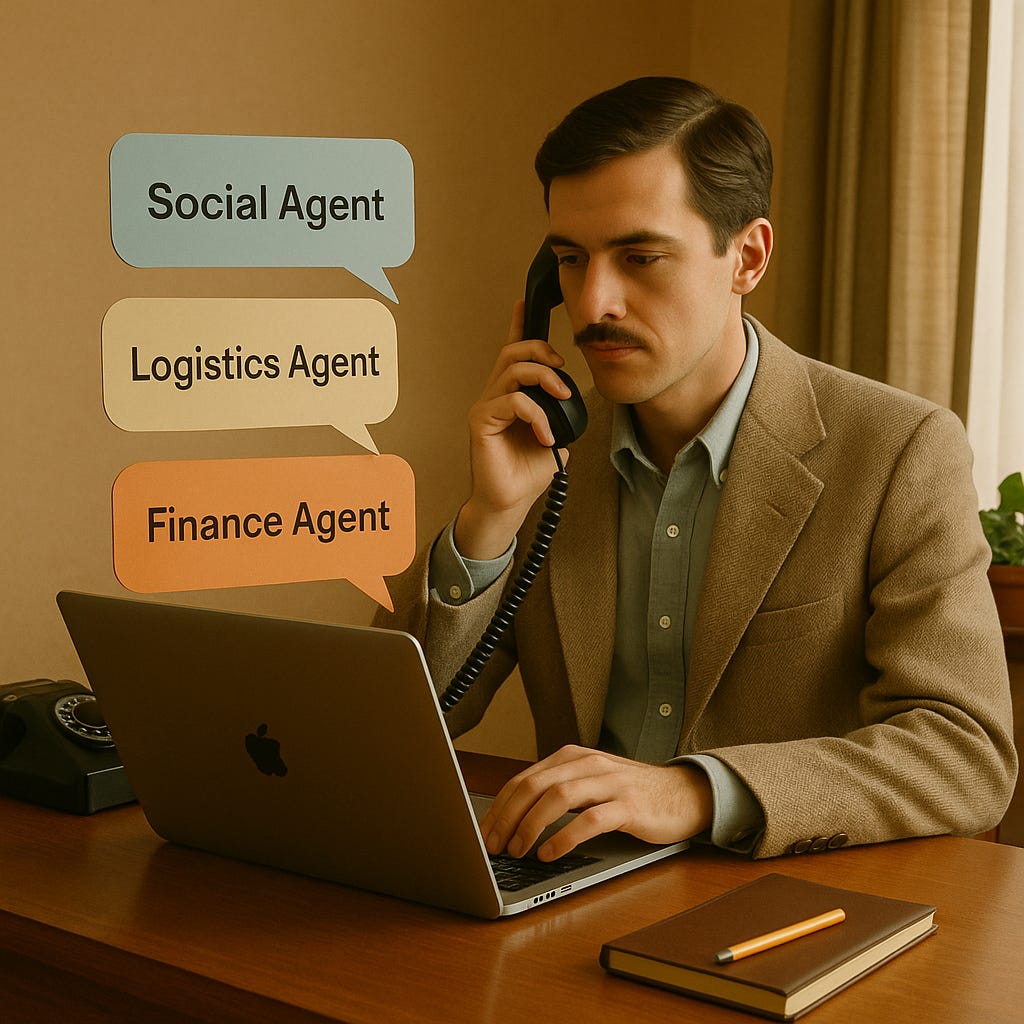
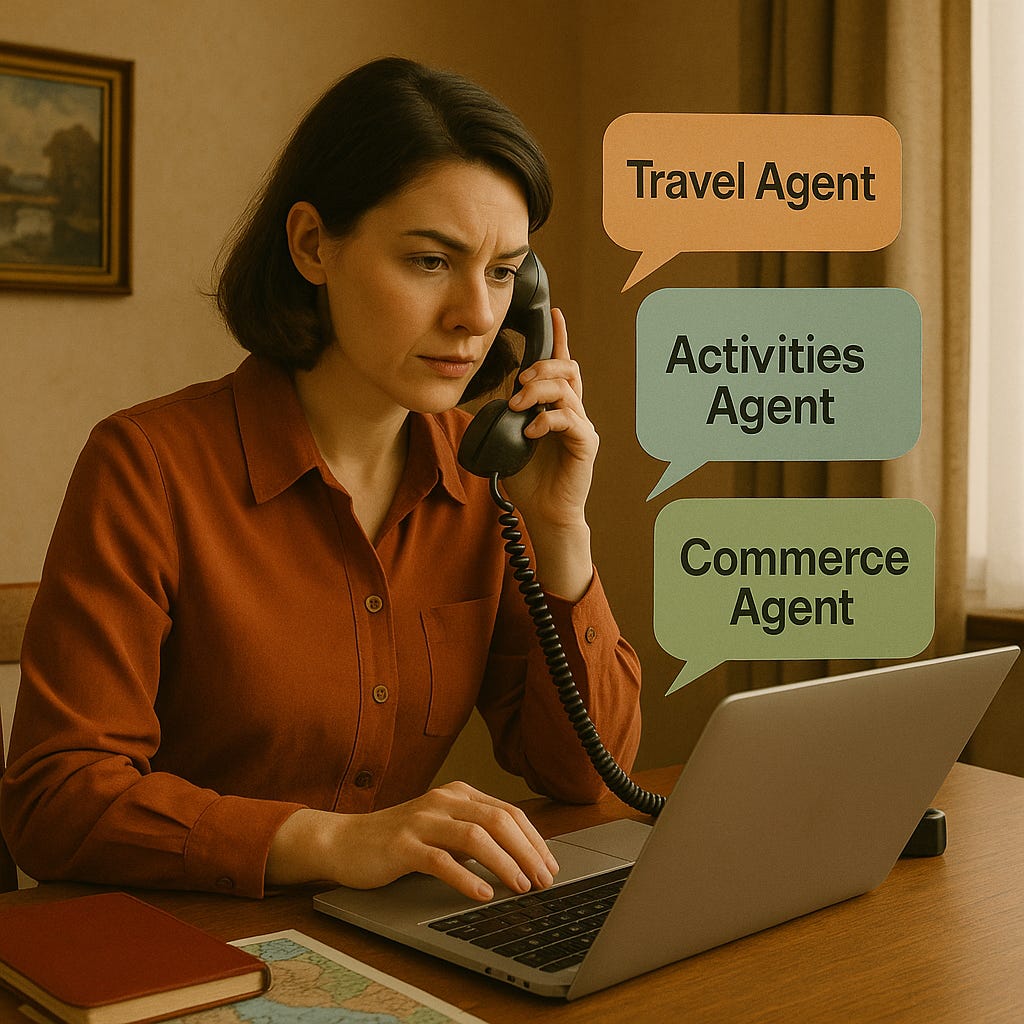
Your Commerce Agent finds the best price, checks delivery windows, tracks cash-back, and makes sure you didn’t accidentally buy six identical black hoodies again.
Your Social Agent manages RSVPs, nudges you when you owe someone a reply, and gently stops you from liking a 7-year-old Instagram post at 2am.
Your Life Admin Agent handles doctor appointments, renews your passport, files your expenses, and reminds you that “No, you cannot move that dentist appointment a fifth time.”
We’ve spent decades building systems that push more and more tasks onto the individual. “Self-service!” they said cheerfully, as they handed us 32 different apps, 12 passwords, and a migraine.
AI agents are the revenge of the user.
Now you get to reply: “Love the portal. You can talk to my agent.”
“Talk to My Agent” for Literally Everything
Let’s imagine a day in the life of Agent-Enhanced You.

Scene 1: The Subscription Showdown
Your streaming platform quietly raises its prices again.
Instead of you spending a Sunday afternoon in chat hell, your Financial Agent notices the change, checks market alternatives, and fires off a polite but firm message:
“Hi, based on Seb’s usage and the current pricing, this increase is not justifiable. Either revert the price or we’ll switch providers by end of week.”
Boom. You’ve become That Customer. The one with boundaries. The one who doesn’t mumble “Guess it’s more expensive now” and move on.
All you see is a notification:
“Price increase withdrawn. Also, you’re still paying for a yoga app you haven’t opened since 2021. Shall I cancel it?”
You glance down at your non-stretched hamstrings.
“Yes. Talk to my agent.”
Scene 2: The Social Calendar Battle
You get a message:
“We should totally catch up soon! How’s next week?”
Your Social Agent steps in like a seasoned diplomat:
Cross-checks your calendar.
Weighs your energy levels (based on sleep, travel, and how many “I’ll be quick” meetings hit 55 minutes yesterday).
Evaluates the relationship (old friend vs. networking vampire).
Then it replies:
“Seb would love to catch up. He’s free Thursday at 3pm for a virtual coffee, or Saturday late morning in person. Suggest a location you like and I’ll handle the booking.”
You? You were making coffee.
You have effectively become that friend with a PA—without having to actually become that person.
Scene 3: The Commerce Agent Strikes Back
You want to book a trip.
In the Old World, this meant 47 open tabs, three misclicked “Basic Economy” tickets, and a quiet breakdown over seat maps.
In the New World:
You say:
“Agent, I need to be in New York mid-March for 3 days. No red-eyes, aisle seat, hotel near the venue, and keep the budget under $1,500 all-in.”
Your agent:
Combs flights, trains, Ubers, hotels.
Applies your loyalty points.
Avoids hotels that think Wi-Fi is a premium luxury.
Respects your deeply held moral objection to 6am departures.
You get:
“Here are two options that fit your budget and preferences. I recommend Option B: shorter total travel time, better Wi-Fi reviews, and a bakery nearby that sells dangerous amounts of croissants.” (yes, Miami, I found the spot for the best croissant 2025)
You click Accept.
Your agent: “All set. Confirmation in your inbox. Talk to my agent next time you want to overcomplicate things.”

Agents Without the 10% Fee (Or the Ego)
Traditional agents survive on three pillars (see French TV Series):
They know people.
They negotiate.
They take their cut.
AI agents flip that model:
They know systems.
They negotiate with other agents.
They don’t invoice you for 10% plus “miscellaneous expenses” including a suspicious number of lunches.
Instead of one professional gatekeeper standing between you and opportunity, you get:
Agents negotiating with banks on overdraft fees.
Agents shopping your profile to different service providers (“Given Seb’s business history and credit standing, what can you offer?”).
Agents reshaping your personal economics one tiny decision at a time.
It’s the democratization of “representation.”
No red carpet required. Just a decent Wi-Fi signal and a willingness to let go of doing everything manually like a 21st-century peasant.

Everyone Becomes a “Micro-Star”
Here’s the real shift:
In the AI-agent age, everyone starts operating like a micro-star in their own domain.
A freelance designer has agents that handle invoicing, collections, contract negotiation, and even lead generation.
A craft brewer has agents that manage supplier pricing, distribution deals, event bookings, and social content calendars.
A local community organizer has agents that coordinate schedules, secure locations, manage volunteers, and optimize fundraising.
Each of them can now say—without irony:
“You can talk to my agent about that.”
Because the agent doesn’t just exist to protect “Important People.”
It exists to protect attention—the scarcest resource we’ve got.
The star resource isn’t fame. It’s focus.
The Awkward Transition Phase (Because There Always Is One)
Of course, before this all feels natural, we’ll go through a deeply awkward phase.
Picture this:
You: “Hey, let’s get lunch next week.”
Friend: “Sure, loop in my agent.”
You: “Which one?”
Friend: “Personal-social. Not logistics. Logistics handles travel and large events. They get anxious about small talk.”
You’re suddenly CC’ing half a dozen AI entities on a burrito plan.
We’ll wrestle with:
Over-automation: “My agent said no to this dinner because it conflicts with my ‘Quiet Reflection Evening.’ I literally did not sign up for that.”
Agent personality clashes: Your financial agent and your “Treat Yourself” agent having full-blown custody battles over your paycheck.
Status confusion: People who brag about their “level” of agents the way some folks brag about watches or cars. (“Oh, you still use single-agent mode? Cute.”)
But like email, smartphones, and contactless payments, we’ll move from weird to normal faster than you’d think.
Yesterday: “Why would I tap my card instead of swiping?”
Tomorrow: “Why would I call customer service when my agent can?”
The Serious Upside Under the Jokes
Under the humor, there’s something genuinely powerful happening.
AI agents:
Lower the cognitive tax on everyday life.
Level the playing field for people who don’t have admin support, connections, or time.
Shift power away from opaque institutions and toward individuals who now have constant, relentless representation.
When everyone has an agent:
Predatory subscription models become less effective.
Opaque pricing becomes a liability, not an asset.
“Loyalty” means more than just forgetting to cancel before the trial ends.
Companies will have to deal with your agent knowing the market, reading the fine print, and negotiating at scale. And companies will deploy their own agents, leading to vast, mostly polite, automated negotiations where your agent is no longer that one angry customer email—it’s thousands of well-informed, persistent little diplomats.
You get to be the calm center of your own universe while they sort out the gravitational math.
So What Do We Do With This?
A few practical thoughts as we head toward our all-star future:
Get comfortable delegating decisions, not just tasks.
Let your agents choose how to achieve an outcome, not just perform a checklist.
Teach your agents your values.
Not just price, but: privacy, sustainability, local vs global, fairness, “no calls before coffee,” etc.
Stay in the loop on the big stuff.
The goal isn’t to outsource your life. It’s to outsource the parts that prevent you from living it.

Final Scene: You, the Star
We are moving from an era where software made us more busy to an era where agents can make us more present.
Present for the work that actually matters.
Present for the people we care about.
Present for the random Tuesday afternoon where you spontaneously decide to not be on a call and instead go outside.
And when the world comes knocking with:
“We’ve updated our terms…”
“Can you find a time that works…”
“Have you considered upgrading…”
You’ll have a simple, movie-star answer:
“Delighted you’re interested. You can talk to my agent.”
And for once, that line won’t belong to someone on a red carpet.
It’ll belong to you.