
The Vinyl Clock
Why My Record Collection Is a Better Productivity Tool Than My Apple Watch

I’m not a nostalgic person. I don’t collect vinyl because it sounds warmer, or because the ritual of it makes me feel connected to some golden era I half-remember. I collect vinyl because, without meaning to, I discovered it solves a problem that Silicon Valley has been charging me subscription fees to fix: how to actually focus for a sustained stretch of time, and then stop.
Let me explain.
The accidental timer
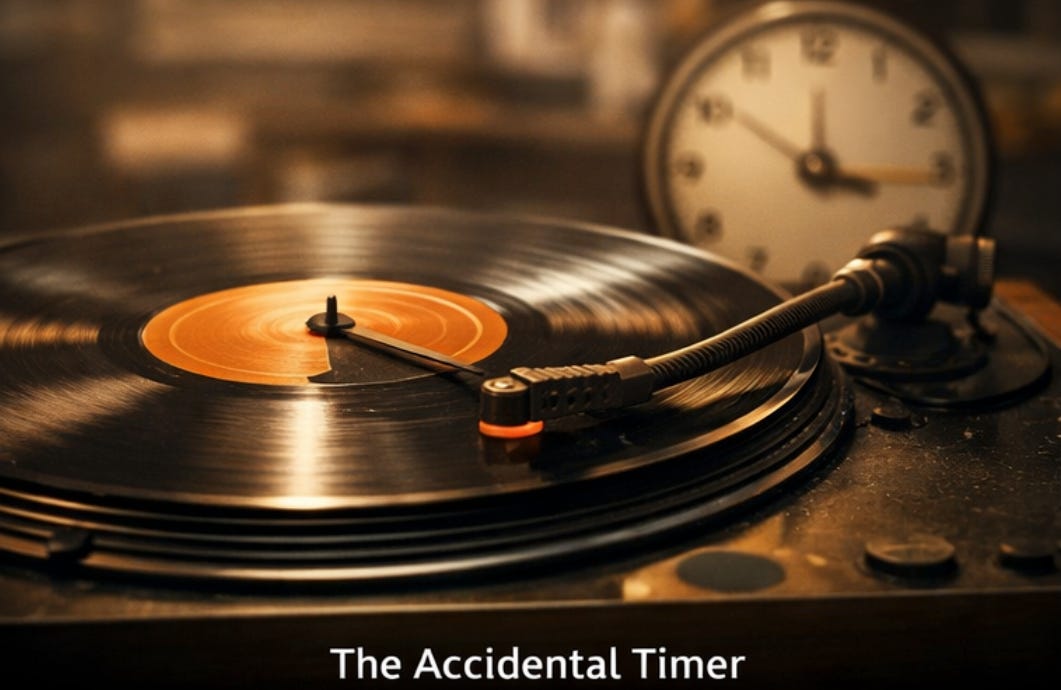
A standard LP side runs somewhere between 15 and 22 minutes. That wasn’t a design choice rooted in human psychology — it was a physical constraint of the medium. The lacquer disc could only hold so many grooves before the audio quality degraded. Engineers in the 1940s and 50s drew the line at roughly 18 minutes per side, and that was that.
Here’s what’s interesting: that constraint turned out to be almost perfectly calibrated to the human brain’s natural attention cycle.
Research on what’s called the ultradian rhythm — the body’s sub-circadian biological pulses — suggests that our ability to sustain focused attention operates in cycles of roughly 90 minutes, punctuated by natural reset windows of about 15 to 20 minutes. The Pomodoro Technique, developed in the 1980s and beloved by productivity enthusiasts ever since, landed on 25-minute work intervals essentially by trial and error. The people who designed it didn’t know they were approximating a biological clock — they just noticed that 25 minutes felt right.
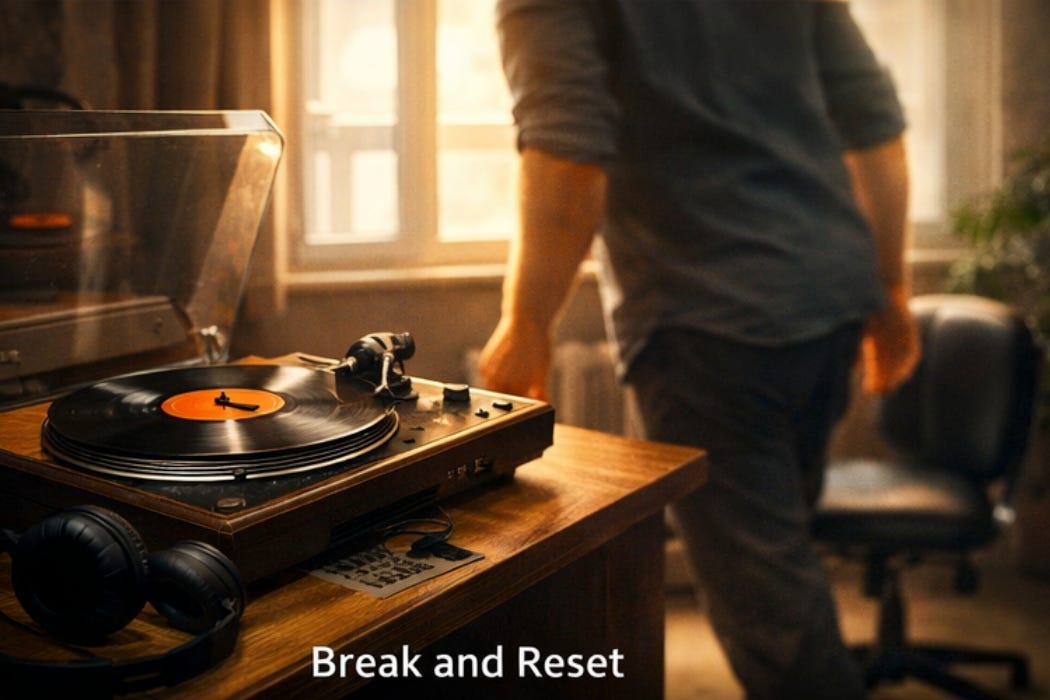
The record side was doing this before Pomodoro had a name. And unlike a phone timer, it didn’t alert you. It ran out of music. You got up, you flipped the record, and in that moment of physical interaction, your focus reset.
The thing nobody talks about: tempo
Here’s where it gets genuinely interesting, and where I think the vinyl generation stumbled onto something that we’ve completely lost in the age of streaming.
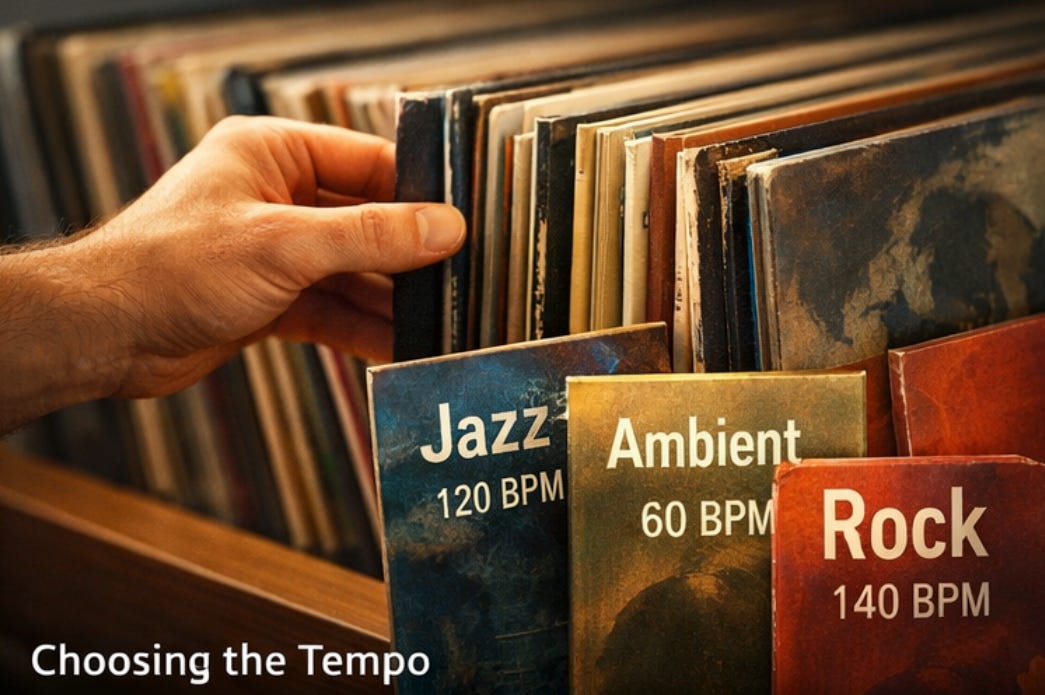
When you put on a record, you’re not just choosing music. You’re choosing a tempo. And tempo, it turns out, has a measurable physiological effect on your body.
Research on auditory-motor entrainment — the way rhythmic sound synchronises with biological rhythms — shows that the BPM of music you’re listening to will, over time, pull your heart rate, breathing, and even your cognitive pace in its direction. A 120 BPM jazz record does something different to your nervous system than an ambient drone at 60 BPM. A driving rhythm at 140 BPM is a different physiological state than the slow pulse of a ballad at 72.
Before Spotify’s algorithmic playlists, before “focus music” became a wellness industry category, people were making this choice manually every 18 minutes. You finished side A of Miles Davis’s Kind of Blue — recorded at a deliberately languid pace that seems to slow time itself — and you had to decide: do I flip to side B, or do I put on something else? That decision was an unconscious act of self-regulation. You were tuning your body like an instrument.
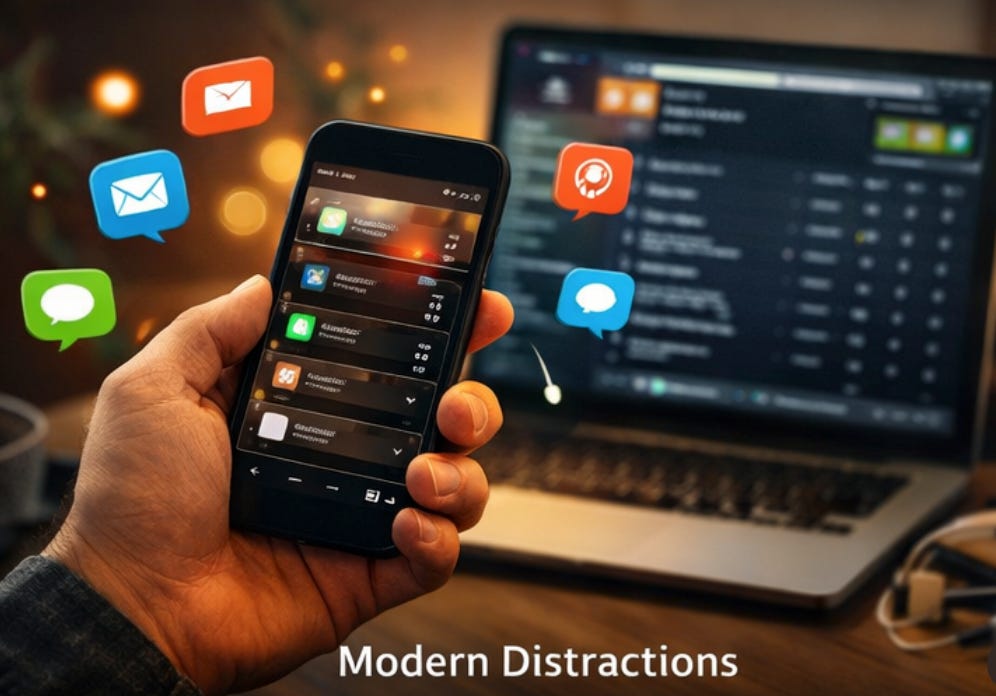
We no longer make that choice. Streaming is designed specifically to remove it. The algorithm keeps playing. The music never runs out. The tempo transitions are smoothed. And we wonder why it’s so hard to get into a flow state.
Paying for what friction used to give us for free
My Apple Watch reminds me to stand up once an hour. I paid several hundred dollars for the privilege of a tap on my wrist telling me to move my body.
My record player costs me nothing to run, and it tells me to stand up every 18 minutes — while also requiring me to make a deliberate, conscious decision about what my auditory environment is going to be for the next stretch of work. The act of choosing a record, lowering the needle, and returning to my desk is a micro-ritual. It takes 90 seconds. And in those 90 seconds, I do something that no productivity app can replicate: I notice where I am, decide if I want to keep going, and choose the tempo for what comes next.
That’s not nostalgia. That’s an interface for the body and mind that modern technology has systematically optimised away.
Were they onto something?
I think the honest answer is: yes, but they didn’t know it.
The generation that grew up with vinyl didn’t consciously design a mind-body productivity system. The technology imposed a rhythm on them that happened to align with their biology. The record ended, you got up, you engaged physically with your listening environment, and you continued or you stopped.
What’s striking is that this generation — my generation — often reports a fundamentally different relationship with sustained attention. We read whole books in one sitting. We spent entire evenings listening to a single album, not as background noise, but as the main event. Whether that’s cause or effect is genuinely hard to untangle. But the structure was there, built into the medium.
The tragedy of streaming isn’t that it sounds worse, or that it’s less physical. It’s that it removed the natural punctuation from our listening. Music became infinite, which sounds like abundance, but functions more like a drip — always on, never demanding that you make a choice, never requiring you to stop and decide.
The case for friction
I’m not going to tell you to throw out your Spotify account. I use it too. But there’s a case to be made for reintroducing deliberate friction into how we consume music during work — not because friction is virtuous, but because it forces a kind of mindfulness that flows naturally from constraint.
Set a timer that runs out. Choose music for its tempo, not just its mood. Stand up when the side ends. Make the decision about what comes next with your whole body, not just a click.
The older generation didn’t have better discipline than us. They had a machine that imposed discipline on them without asking. The vinyl clock was ticking whether they knew it or not.
The question is whether we’re willing to wind it back up.
How do you manage your attention during deep work? I’m genuinely curious whether others have noticed the difference between “music as background” and “music as timer.” Find me in the comments.